Economy
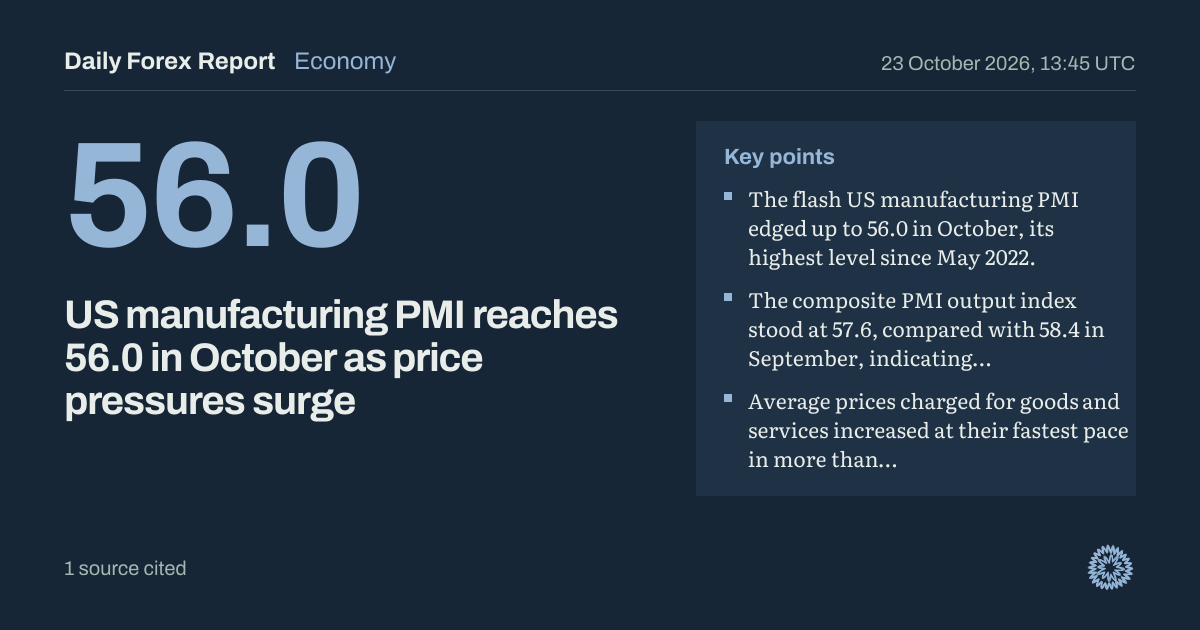
US manufacturing PMI reaches 56.0 in October as price pressures surge
The S&P Global US manufacturing PMI climbed to 56.0 in October, a 53-month high, while average selling prices charged by businesses rose at the fastest pace in over four years.
Key points
- The flash US manufacturing PMI edged up to 56.0 in October, its highest level since May 2022.
- The composite PMI output index stood at 57.6, compared with 58.4 in September, indicating solid economic expansion.
- Average prices charged for goods and services increased at their fastest pace in more than four years.
Business activity across the United States expanded at a robust pace at the start of the fourth quarter, according to flash survey data published by S&P Global on October 23. The headline S&P Global Flash US Manufacturing PMI rose to 56.0 in October from 55.9 in September, reaching its highest level in 53 months.
The services sector also maintained strong momentum. The Flash US Services PMI Business Activity Index recorded 57.9 in October compared with 58.8 in September. The headline Flash US PMI Composite Output Index, which tracks combined output across manufacturing and service sectors, registered 57.6, easing slightly from September's five-year peak of 58.4 but remaining firmly above the 50.0 mark that divides expansion from contraction.
Inflation gauges within the report signaled renewed price pressures. Rates of both input cost and selling price inflation accelerated sharply across both manufacturing and service providers. S&P Global reported that average prices charged for goods and services rose at the fastest pace in over four years, driven higher by rising oil prices, shipping constraints, and elevated wage demands.
Employment indicators showed continuing job creation, with manufacturing payrolls expanding at the quickest rate in nearly two years to meet backlogs. However, business confidence regarding the 12-month outlook slipped to its lowest level since April, tempered by geopolitical uncertainty and higher financing costs.
The survey results arrive days before the Federal Open Market Committee convenes on October 27 and 28. Robust output growth combined with accelerating pipeline price pressures reinforces market expectations that the Federal Reserve will maintain a restrictive policy stance well into 2027.