Central banks
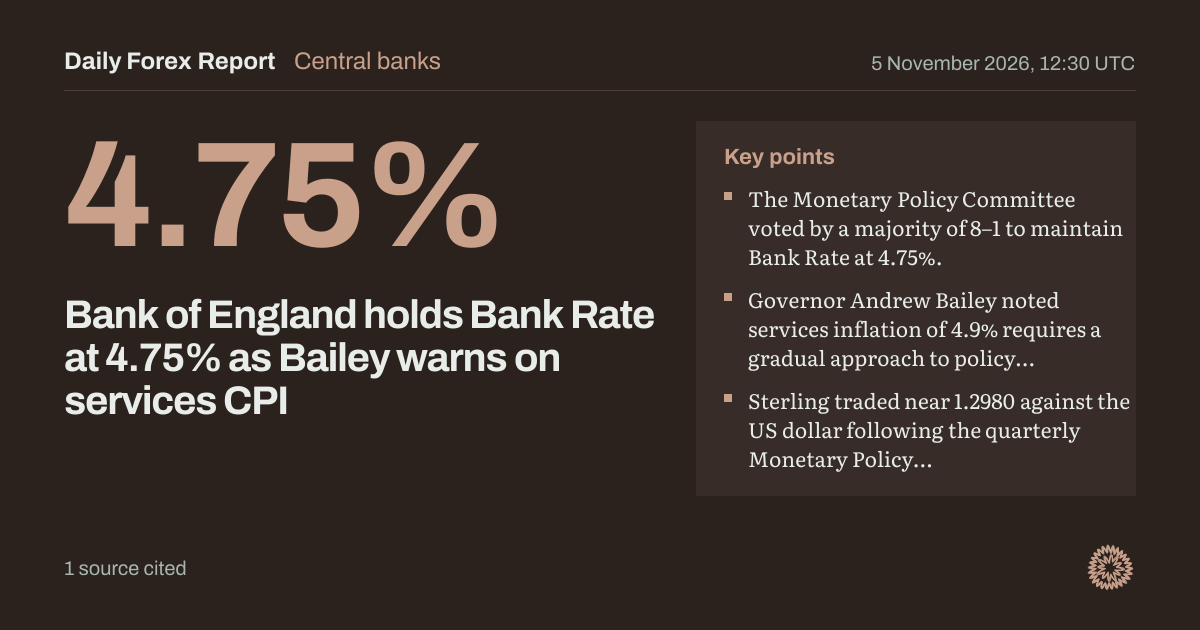
Bank of England holds Bank Rate at 4.75% as Bailey warns on services CPI
The Bank of England kept Bank Rate at 4.75% on Thursday, with Governor Andrew Bailey stating that services inflation and private wage growth remain too high to accelerate rate cuts.
Key points
- The Monetary Policy Committee voted by a majority of 8–1 to maintain Bank Rate at 4.75%.
- Governor Andrew Bailey noted services inflation of 4.9% requires a gradual approach to policy easing.
- Sterling traded near 1.2980 against the US dollar following the quarterly Monetary Policy Report.
The Bank of England concluded its scheduled monetary policy meeting in London on Thursday, November 5, voting by an 8-to-1 majority to keep Bank Rate unchanged at 4.75 percent, resisting calls for immediate policy easing amid sticky services inflation and persistent wage growth.
In its updated quarterly Monetary Policy Report, the Monetary Policy Committee emphasized that while headline consumer price inflation has receded toward target, core domestic inflationary dynamics continue to demand monetary restraint. The Committee noted that annual services price inflation printed at 4.9 percent in September, while regular private-sector wage expansion held near 4.8 percent, driven by ongoing tightness across UK service and hospitality sectors.
Speaking during his post-meeting press conference at Threadneedle Street, Governor Andrew Bailey outlined a cautious policy trajectory. Bailey reiterated that interest rates will need to remain restrictive for sufficiently long until the risks to inflation returning sustainably to the 2 percent target have dissipated further. The Governor added that recent UK fiscal announcements and volatile international oil benchmarks above 115 dollars per barrel create two-sided risks that warrant a measured, meeting-by-meeting approach.
Financial markets interpreted the policy announcement as a moderately hawkish hold. Benchmark 10-year UK gilt yields rose four basis points to 4.45 percent, while the British pound traded defensively near 1.2980 against the US dollar, reflecting broader greenback strength ahead of Friday's US employment figures.