Economy
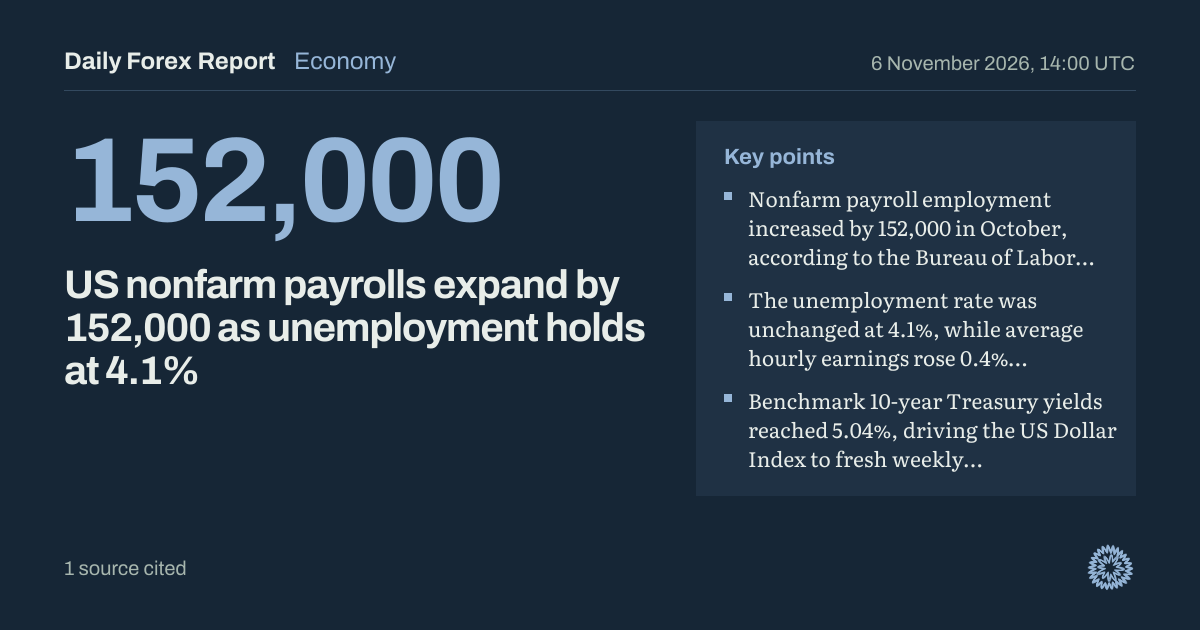
US nonfarm payrolls expand by 152,000 as unemployment holds at 4.1%
US employers added 152,000 jobs in October while the unemployment rate held at 4.1%, keeping benchmark 10-year Treasury yields above 5.04% as the dollar surged.
Key points
- Nonfarm payroll employment increased by 152,000 in October, according to the Bureau of Labor Statistics.
- The unemployment rate was unchanged at 4.1%, while average hourly earnings rose 0.4% month-on-month.
- Benchmark 10-year Treasury yields reached 5.04%, driving the US Dollar Index to fresh weekly highs.
The United States labor market expanded at a steady pace in October despite regional severe weather disruptions, according to data released by the Bureau of Labor Statistics on Friday, November 6, reaffirming underlying domestic economic resilience.
Total nonfarm payroll employment increased by 152,000 positions in October, matching consensus expectations and confirming that hiring remains durable across non-cyclical sectors. Healthcare, social assistance, and government employers accounted for the majority of new payroll additions, offsetting minor labor contractions across transportation and warehousing. The headline unemployment rate remained unchanged at 4.1 percent for the third consecutive month, consistent with a historically balanced labor market.
Wage metrics reinforced the Federal Reserve's cautious monetary policy stance. Average hourly earnings for all private-sector employees rose by 0.4 percent from the prior month, bringing the annual wage growth rate to 4.0 percent. The persistent strength in worker compensation indicates that service sector price pressures will continue to filter through consumer expenditure channels over coming quarters.
Financial markets responded with a sharp upward repricing across global interest rate curves. The yield on benchmark 10-year US Treasury notes jumped six basis points to trade at 5.04 percent, touching its highest level since mid-October. The US Dollar Index advanced above 104.60, registering widespread gains against the euro, Japanese yen, and British pound as futures traders deferred expectations for Federal Reserve policy easing further into 2027.