Central banks
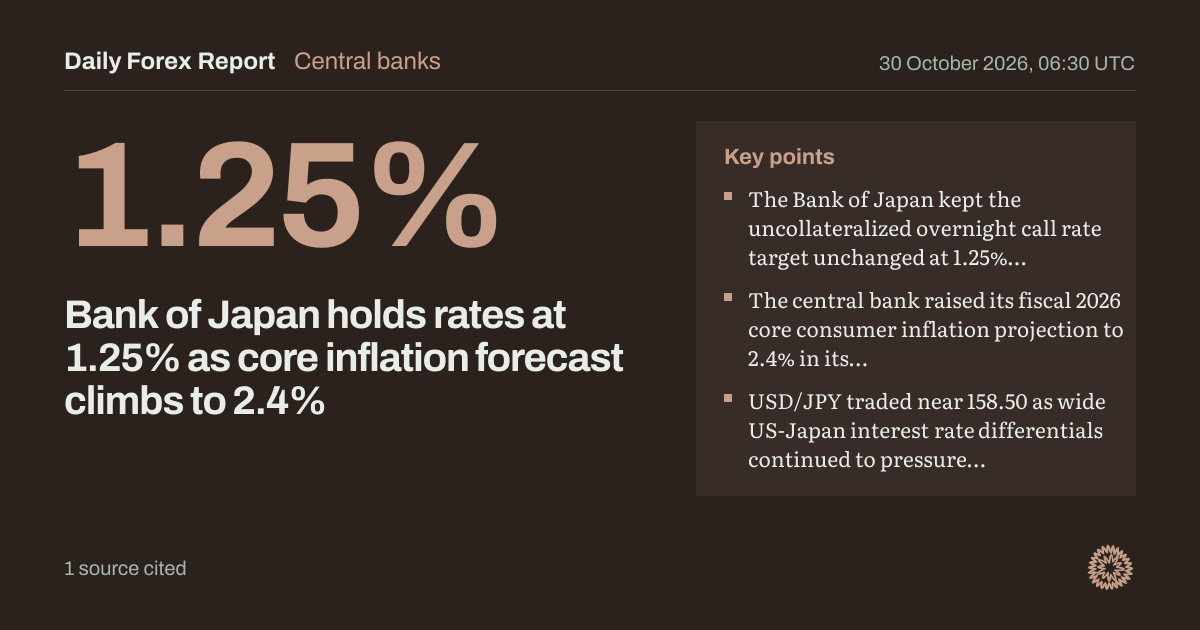
Bank of Japan holds rates at 1.25% as core inflation forecast climbs to 2.4%
The Bank of Japan kept its policy rate at 1.25% on Friday, raising its core inflation outlook to 2.4% while Governor Kazuo Ueda signaled caution on domestic consumer spending.
Key points
- The Bank of Japan kept the uncollateralized overnight call rate target unchanged at 1.25% following a unanimous vote.
- The central bank raised its fiscal 2026 core consumer inflation projection to 2.4% in its quarterly Outlook Report.
- USD/JPY traded near 158.50 as wide US-Japan interest rate differentials continued to pressure the yen.
The Bank of Japan concluded its two-day monetary policy meeting on Friday, October 30, voting unanimously to leave its uncollateralized overnight call rate target unchanged at 1.25 percent, taking a pause following its historic policy rate increase in September.
In its quarterly Outlook for Economic Activity and Prices, the Policy Board revised its fiscal 2026 core consumer inflation projection upward to 2.4 percent, citing persistent import cost pressures driven by higher international crude oil prices and global logistical disruptions. However, economic growth estimates were adjusted slightly lower, reflecting subdued household real income growth and sluggish private consumption expenditure.
During his post-meeting press conference in Tokyo, Governor Kazuo Ueda explained that while the Japanese economy continues to recover moderately, policymakers require further concrete evidence of sustainable wage-driven domestic demand before considering additional adjustments to borrowing costs. Ueda noted that the central bank is closely monitoring foreign exchange volatility and its swift transmission into domestic consumer goods pricing, reiterating that exchange-rate movements remain an important factor in monetary deliberations.
Financial markets responded with renewed downward pressure on the Japanese currency. Spot USD/JPY pushed higher toward 158.50 during afternoon trading in Asia, as investors recognized that the widening gap between Japanese yields and near 5 percent US Treasury yields continues to favor capital flows into dollar-denominated assets.
Later in the global session, the US Bureau of Economic Analysis reported that the headline Personal Consumption Expenditures price index rose 0.3 percent in September, with core PCE holding steady at 2.7 percent year-on-year. The data corroborated the Federal Reserve's cautious policy guidance, keeping the dollar broadly supported across G10 currency pairs.