Economy
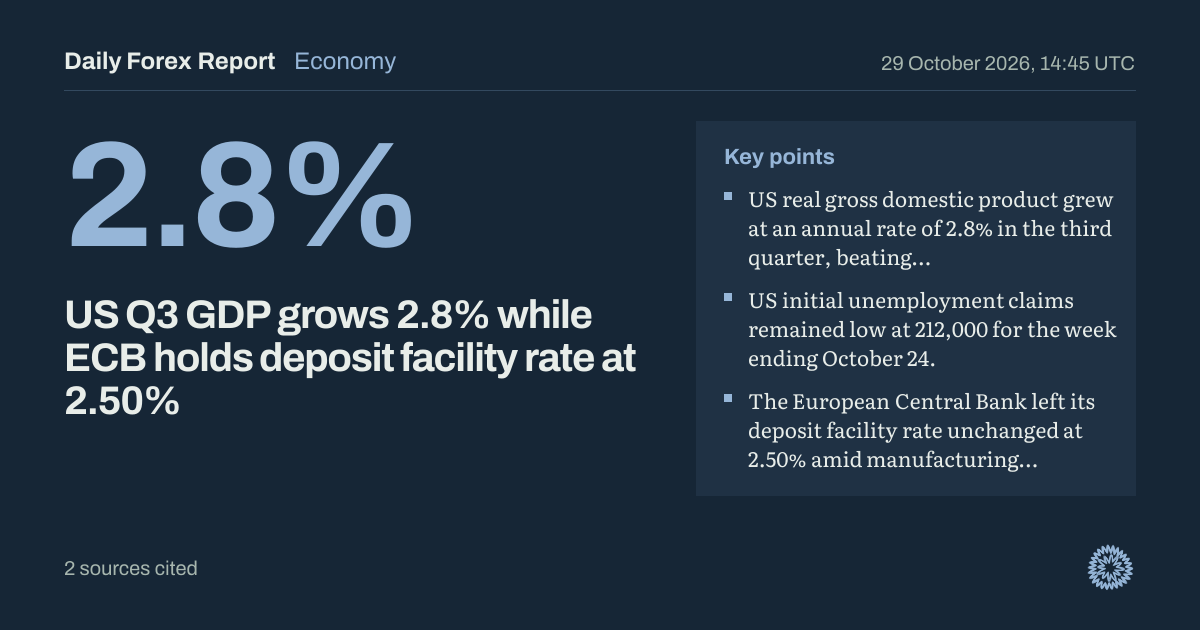
US Q3 GDP grows 2.8% while ECB holds deposit facility rate at 2.50%
US GDP grew 2.8% annualized in the third quarter while the ECB held its deposit rate at 2.50%, underscoring divergent economic trajectories between the US and the Eurozone.
Key points
- US real gross domestic product grew at an annual rate of 2.8% in the third quarter, beating consensus estimates of 2.4%.
- US initial unemployment claims remained low at 212,000 for the week ending October 24.
- The European Central Bank left its deposit facility rate unchanged at 2.50% amid manufacturing weakness.
Economic divergence between the United States and Europe deepened on Thursday, October 29, as robust American growth figures contrasted with cautious policy hold signals from Frankfurt.
In Washington, the Bureau of Economic Analysis reported that US real gross domestic product increased at an annual rate of 2.8 percent in the third quarter of 2026, exceeding consensus expectations of 2.4 percent. Consumer spending and enterprise investment in technology equipment served as the primary growth drivers, underscoring the surprising resilience of domestic demand despite elevated borrowing costs. Simultaneously, the Department of Labor reported initial unemployment insurance claims held at a subdued 212,000 for the week ending October 24, confirming continued labor market stability.
Hours earlier, the European Central Bank Governing Council held its key interest rates steady, leaving the deposit facility rate at 2.50 percent, the main refinancing rate at 2.65 percent, and the marginal lending facility rate at 2.90 percent. The decision reflected balancing acts confronting European policymakers. While recent business surveys, including Germany's ifo index dropping to 85.4, highlight persistent industrial stagnation, crude oil prices above 115 dollars per barrel preclude aggressive monetary easing.
ECB President Christine Lagarde stated during her press conference that the disinflationary process remains on track but acknowledged that elevated geopolitical tensions and energy supply bottlenecks create two-sided risks to medium-term economic projections.
In foreign exchange markets, the transatlantic growth gap exerted immediate downward pressure on the single currency. The euro declined to an intraday low of 1.0735 against the US dollar, while European sovereign bond yields traded mixed as investors digested the divergent monetary outlooks.