Economy
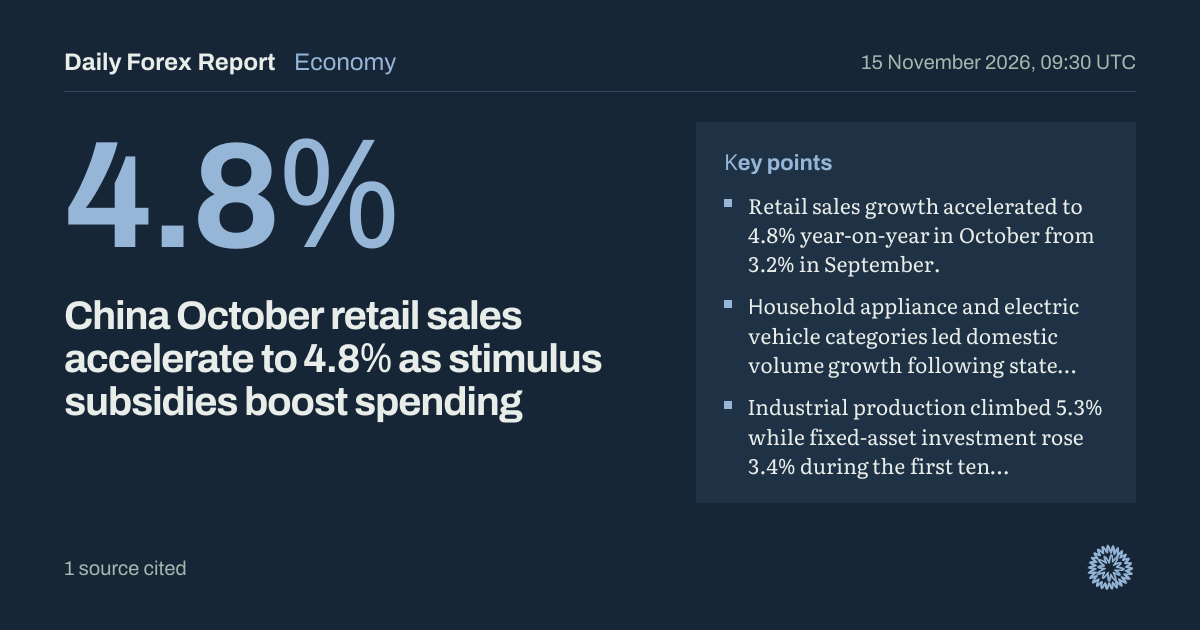
China October retail sales accelerate to 4.8% as stimulus subsidies boost spending
China retail sales grew 4.8% year-on-year in October as government consumer trade-in subsidies supported household electronics and automotive spending.
Key points
- Retail sales growth accelerated to 4.8% year-on-year in October from 3.2% in September.
- Household appliance and electric vehicle categories led domestic volume growth following state subsidy rollouts.
- Industrial production climbed 5.3% while fixed-asset investment rose 3.4% during the first ten months of the year.
Domestic consumption across mainland China registered a pronounced rebound through October, according to official data published by the National Bureau of Statistics on Sunday, November 15, as targeted fiscal subsidies and nationwide consumer trade-in initiatives provided tangible support to household demand.
Headline retail sales expanded by 4.8 percent year-on-year in October, accelerating sharply from the 3.2 percent increase recorded in September and outperforming median financial market forecasts. Consumer durable goods witnessed the strongest surge, with household appliance purchases jumping nearly thirty percent after municipal governments distributed targeted procurement vouchers and tax incentives for energy-efficient upgrades.
The industrial and production components of the statistical release painted a picture of broad-based stabilization across export-oriented supply chains. Factory output increased by 5.3 percent year-on-year, supported by semiconductor fabrication, renewable power generation equipment, and commercial transport assembly. Fixed-asset investment expanded at an annualized 3.4 percent rate through the first ten months of 2026, sustained by public infrastructure allocations.
Global currency and commodity markets reacted positively to signs of demand stabilization in the world's second-largest economy. The Australian dollar advanced twenty-five pips to trade near 0.6580, while copper futures on the London Metal Exchange recovered toward $9,120 per metric ton as speculative traders covered short positions ahead of next week's Asian trading sessions.