Central banks
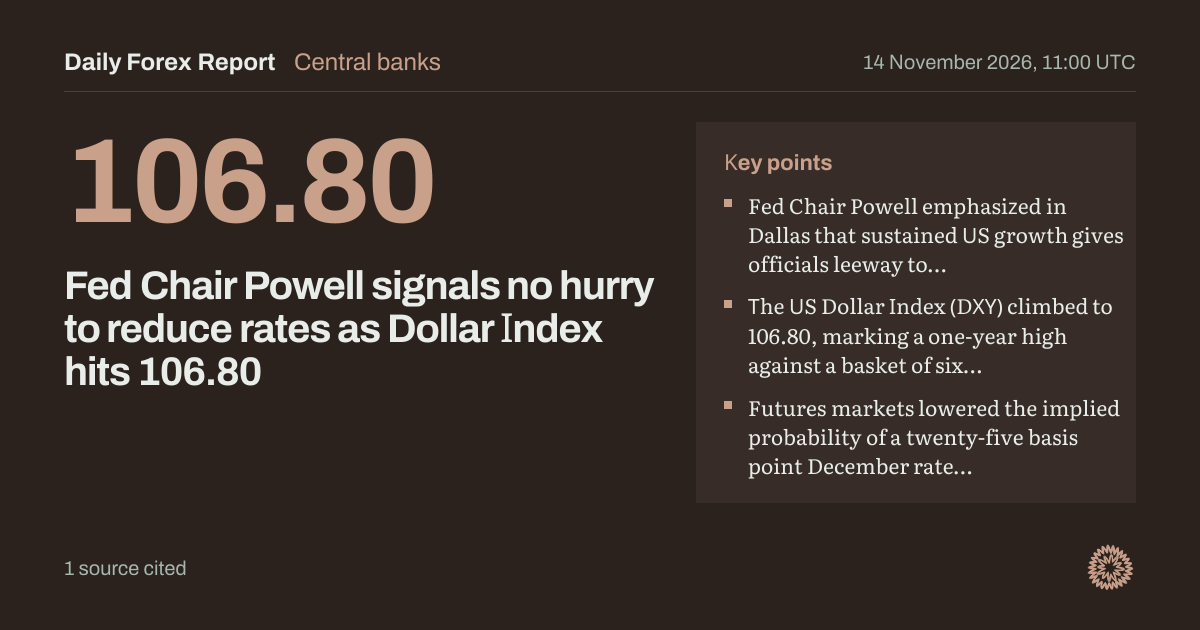
Fed Chair Powell signals no hurry to reduce rates as Dollar Index hits 106.80
Federal Reserve Chair Jerome Powell stated the US economy exhibits strength, allowing policymakers to approach interest rate cuts deliberately.
Key points
- Fed Chair Powell emphasized in Dallas that sustained US growth gives officials leeway to evaluate policy without urgency.
- The US Dollar Index (DXY) climbed to 106.80, marking a one-year high against a basket of six major currencies.
- Futures markets lowered the implied probability of a twenty-five basis point December rate reduction to fifty-eight percent.
Federal Reserve Chair Jerome Powell delivered a decisive monetary policy message on Friday in Dallas, stating that robust economic expansion, stable labor markets, and lingering inflation pressures mean the central bank is in no hurry to lower interest rates aggressively.
Speaking before business leaders, Powell underscored that the United States economy continues to outperform global peers across consumer expenditure, business investment, and productivity metrics. 'The economy is not sending any signals that we need to be in a hurry to lower rates,' Powell noted during his prepared remarks, adding that strong conditions afford policymakers the ability to calibrate policy decisions with measured deliberation.
Financial markets moved swiftly to reprice future interest rate trajectories following the chair's hawkish guidance. The implied probability of another 25 basis point reduction at the upcoming December Federal Open Market Committee meeting declined from over eighty percent earlier in the week to fifty-eight percent, according to CME FedWatch pricing data. Benchmark two-year Treasury yields rose six basis points to 4.36 percent.
The foreign exchange response was characterized by broad-based US dollar appreciation across the G10 currency complex. The US Dollar Index rallied past 106.80 to register its highest level in over twelve months. The euro dropped toward 1.0530, while spot gold slipped under $2,570 per troy ounce as higher real interest rate expectations diminished investor demand for non-yielding bullion assets.