Economy
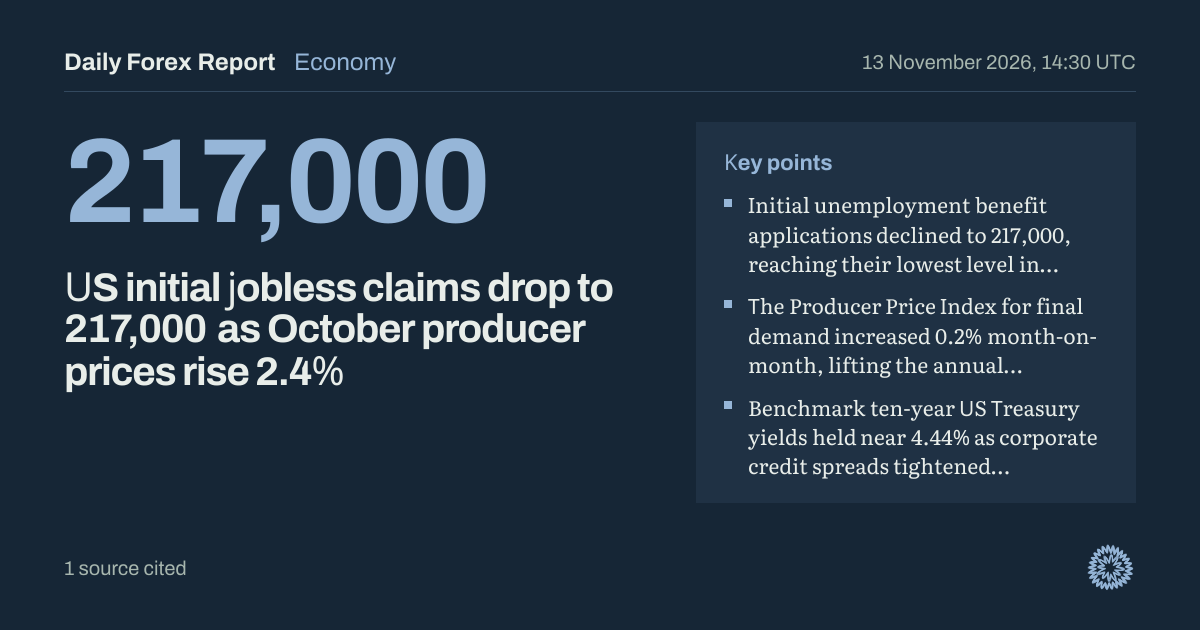
US initial jobless claims drop to 217,000 as October producer prices rise 2.4%
US initial jobless claims fell by 4,000 to 217,000 while October wholesale producer prices rose 2.4% year-on-year, illustrating economic resilience.
Key points
- Initial unemployment benefit applications declined to 217,000, reaching their lowest level in six months.
- The Producer Price Index for final demand increased 0.2% month-on-month, lifting the annual headline rate to 2.4%.
- Benchmark ten-year US Treasury yields held near 4.44% as corporate credit spreads tightened across primary markets.
The United States macroeconomic backdrop displayed enduring resilience on Thursday, November 13, as official government reports confirmed a healthy drop in unemployment benefit filings alongside a modest acceleration in wholesale factory-gate prices.
According to data published by the Department of Labor, initial state unemployment insurance claims fell by 4,000 to a seasonally adjusted 217,000 for the week ending November 8, matching median Wall Street expectations and touching their lowest weekly level since May. Continuing claims, which measure the total population receiving ongoing jobless benefits, fell by 11,000 to 1.87 million, underscoring solid private sector worker retention.
Simultaneously, the Bureau of Labor Statistics released its October Producer Price Index report, revealing that wholesale inflation picked up slightly at the start of the final quarter. Final demand PPI advanced 0.2 percent on a monthly basis, driven primarily by cost increases across portfolio management services, airline transport tariffs, and retail food processing. On an annualized basis, headline producer prices climbed 2.4 percent, up from 1.9 percent in September.
Foreign exchange and debt markets absorbed the dual reports with orderly firmness across dollar denominated assets. Spot EUR/USD met firm selling interest near 1.0560, while the Japanese yen traded defensively near 156.20 per dollar. Fixed income traders noted that low layoff volumes combined with sticky production costs reinforce expectations for a shallower Federal Reserve easing cycle throughout 2027.