Central banks
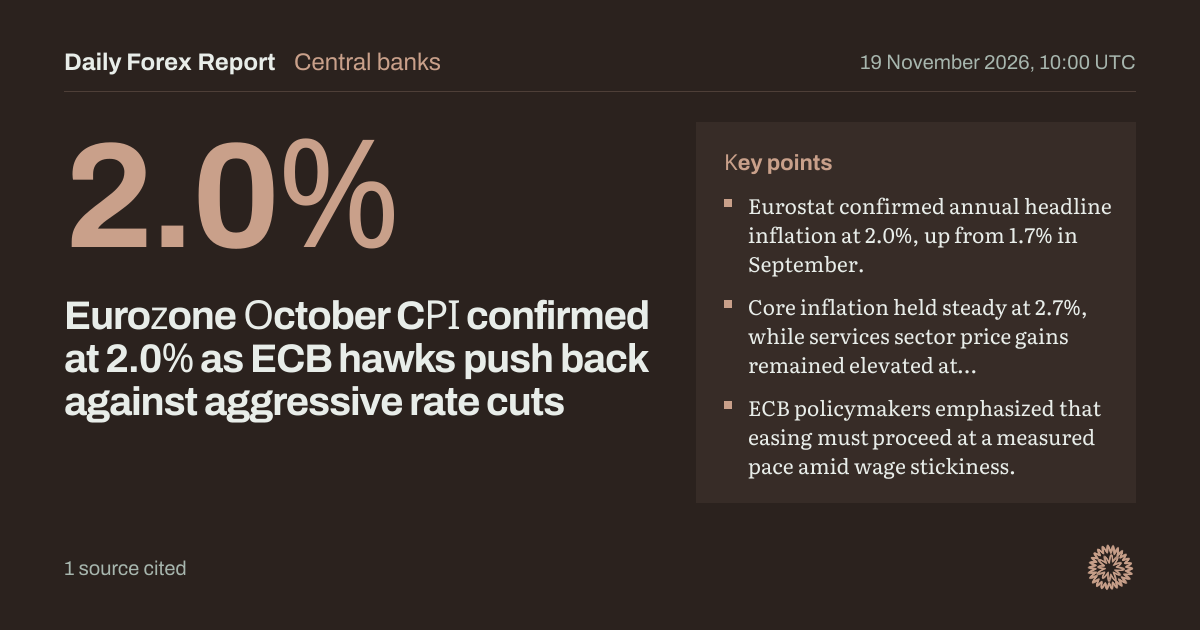
Eurozone October CPI confirmed at 2.0% as ECB hawks push back against aggressive rate cuts
Eurozone annual inflation was finalized at 2.0% for October, reinforcing hawkish ECB arguments against a 50 basis point rate reduction in December.
Key points
- Eurostat confirmed annual headline inflation at 2.0%, up from 1.7% in September.
- Core inflation held steady at 2.7%, while services sector price gains remained elevated at 3.9%.
- ECB policymakers emphasized that easing must proceed at a measured pace amid wage stickiness.
Consumer price inflation across the twenty-nation Eurozone was finalized at an annualized rate of 2.0 percent in October, matching preliminary flash estimates, according to the final statistical release published by Eurostat on Thursday, November 19. The result marks an increase from the 1.7 percent recorded in September, returning price growth squarely to the European Central Bank medium-term mandate.
Underlying inflationary measures continued to display divergence between sectors. Core inflation, which strips away energy, food, alcohol, and tobacco costs, was confirmed at 2.7 percent year-on-year. While industrial goods prices remained subdued due to ongoing manufacturing weakness, services sector inflation remained elevated at 3.9 percent, bolstered by negotiated wage settlements and persistent price gains in hospitality and recreation.
The confirmation of inflation at the target threshold reinforced statements from conservative members of the ECB Governing Council who oppose oversized interest rate reductions. Influential policymakers, including Bundesbank President Joachim Nagel, reiterated that while disinflation remains on track, monetary authorities should proceed cautiously rather than rushing into half-point rate cuts. In European financial markets, the benchmark deposit facility rate is widely expected to be trimmed by standard 25 basis points at the final 2026 monetary policy meeting in December, leaving EUR/USD fluctuating around the 1.0550 level.
National data within the report illustrated uneven progress across member states, with German inflation accelerating to 2.4 percent while French and Spanish metrics hovered below the bloc-wide benchmark. The persistent disparity underscores the complex calibration facing Frankfurt as it attempts to support stumbling industrial output without re-igniting service sector inflationary pressures.