Economy
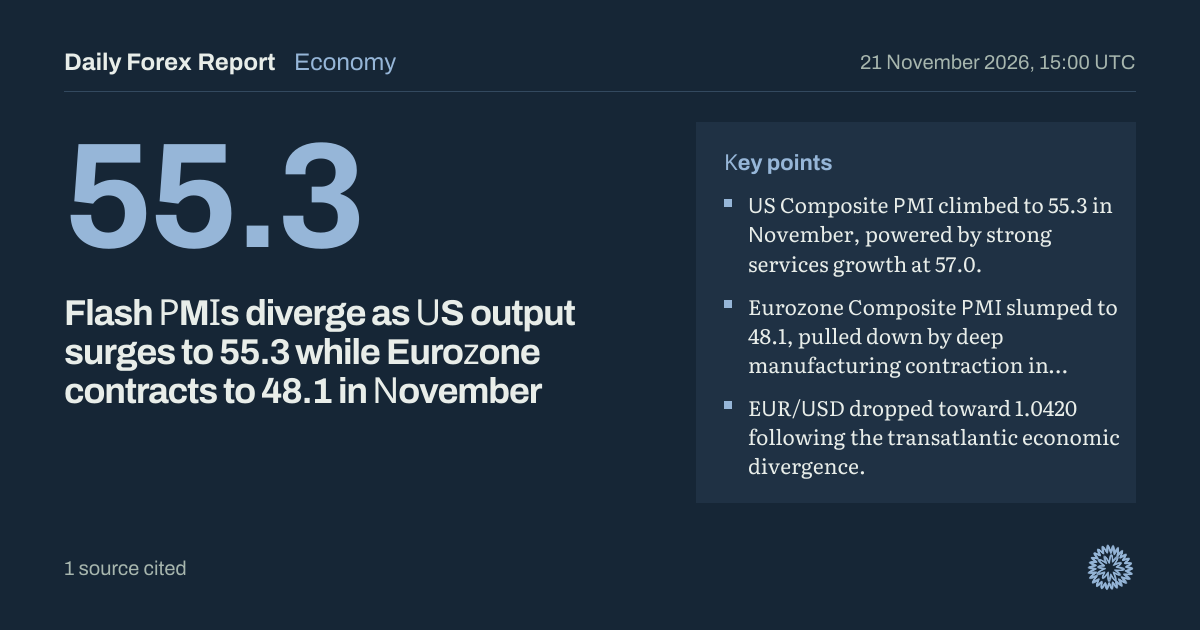
Flash PMIs diverge as US output surges to 55.3 while Eurozone contracts to 48.1 in November
Global flash PMIs showed widening divergence as US business activity accelerated to 55.3, while Eurozone output fell into contraction at 48.1.
Key points
- US Composite PMI climbed to 55.3 in November, powered by strong services growth at 57.0.
- Eurozone Composite PMI slumped to 48.1, pulled down by deep manufacturing contraction in Germany.
- EUR/USD dropped toward 1.0420 following the transatlantic economic divergence.
Transatlantic economic momentum diverged sharply in November according to flash Purchasing Managers Index surveys released by S&P Global on Saturday, November 21. Business activity across the United States accelerated to its fastest pace in thirty-one months, while economic conditions across the Eurozone slipped back into contraction territory under the weight of persistent manufacturing headwinds.
The S&P Global flash US Composite PMI Output Index climbed from 54.1 in October to 55.3 in November, comfortably above the 50.0 neutral threshold. Expansion was driven almost entirely by the services sector, where business activity printed at 57.0, supported by resilient consumer spending and robust corporate services demand. In contrast, manufacturing output remained subdued at 48.8, reflecting cautious capital investment.
Across the Atlantic, the Eurozone Flash Composite PMI slumped from 50.0 to 48.1 in November, touching a ten-month low. German industrial activity deteriorated further, with German manufacturing PMI dropping to 43.2. The widening performance gap between the US and European economies triggered fresh capital flows into dollar-denominated assets, pushing EUR/USD down toward 1.0420, its weakest level in over a year.
The severe contraction in European industrial indicators sparked growing calls among economists for the European Central Bank to accelerate monetary policy easing to avert a protracted economic stall. With inflation stabilizing near target and private sector order books shrinking, market observers anticipate that monetary policy divergence between the Federal Reserve and the ECB will remain a primary trading theme heading into the new year.