Economy
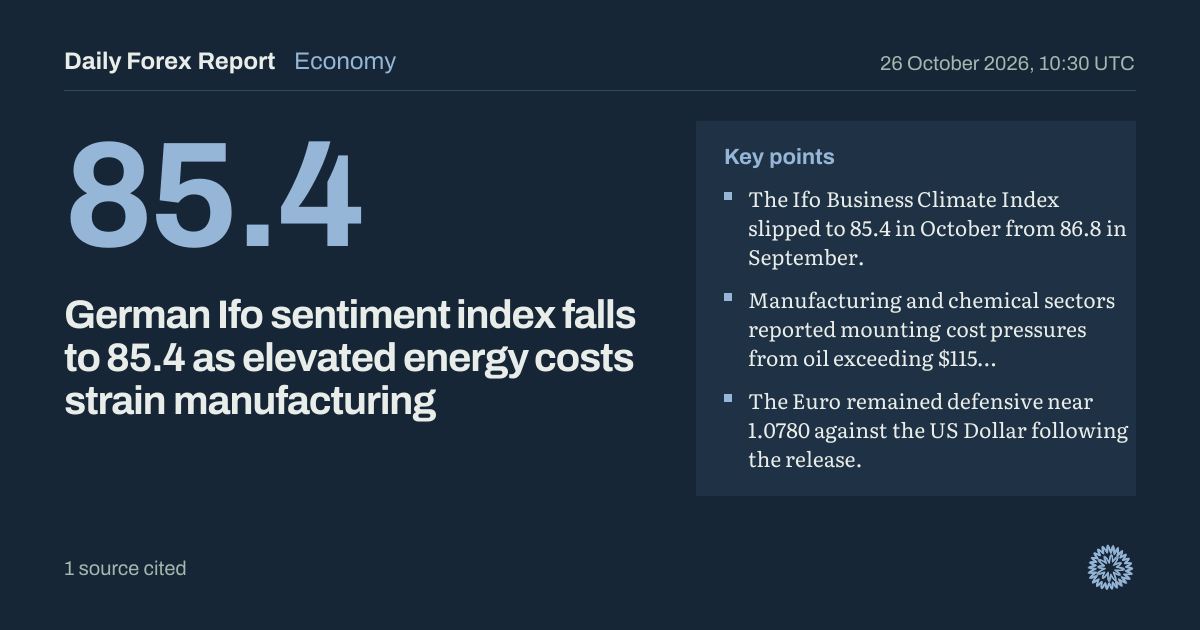
German Ifo sentiment index falls to 85.4 as elevated energy costs strain manufacturing
German business morale deteriorated in October as the Ifo index dropped to 85.4, pressured by surging crude benchmarks above $115 and declining industrial order backlogs.
Key points
- The Ifo Business Climate Index slipped to 85.4 in October from 86.8 in September.
- Manufacturing and chemical sectors reported mounting cost pressures from oil exceeding $115 per barrel.
- The Euro remained defensive near 1.0780 against the US Dollar following the release.
German business sentiment deteriorated further heading into late autumn as the ifo Business Climate Index declined to 85.4 points in October from 86.8 points recorded in September, according to data released on Monday, October 26, by the ifo Institute in Munich.
The survey of roughly 9,000 corporate managers indicated widespread gloom across core industrial segments, with both current assessment metrics and forward-looking six-month business expectations retreating. Manufacturers reported persistent weakness in domestic and international order books, compounded by rising input costs following the resurgence of global crude oil benchmarks past 115 dollars a barrel.
Energy-intensive manufacturing branches, notably basic chemicals, plastics, automotive supply chains, and metal processing, noted sharp increases in procurement expenses. Rising electricity and transport fuel costs have compressed operating margins, prompting German industrial firms to postpone capital expenditure plans and scale back production shifts heading into the winter quarter.
The deepening manufacturing slump adds to policy challenges confronting the European Central Bank ahead of its monetary policy meeting on Thursday, October 29. While headline inflation pressures remain elevated due to the recent energy supply shock, sluggish economic momentum across Germany and France limits the scope for further monetary tightening without risking a broader economic contraction.
In currency markets, the euro traded on the defensive against the US dollar following the release, hovering near 1.0780. Foreign exchange analysts note that ongoing divergence between steady US macroeconomic growth and subdued European activity continues to favor the greenback across spot currency transactions.