Economy
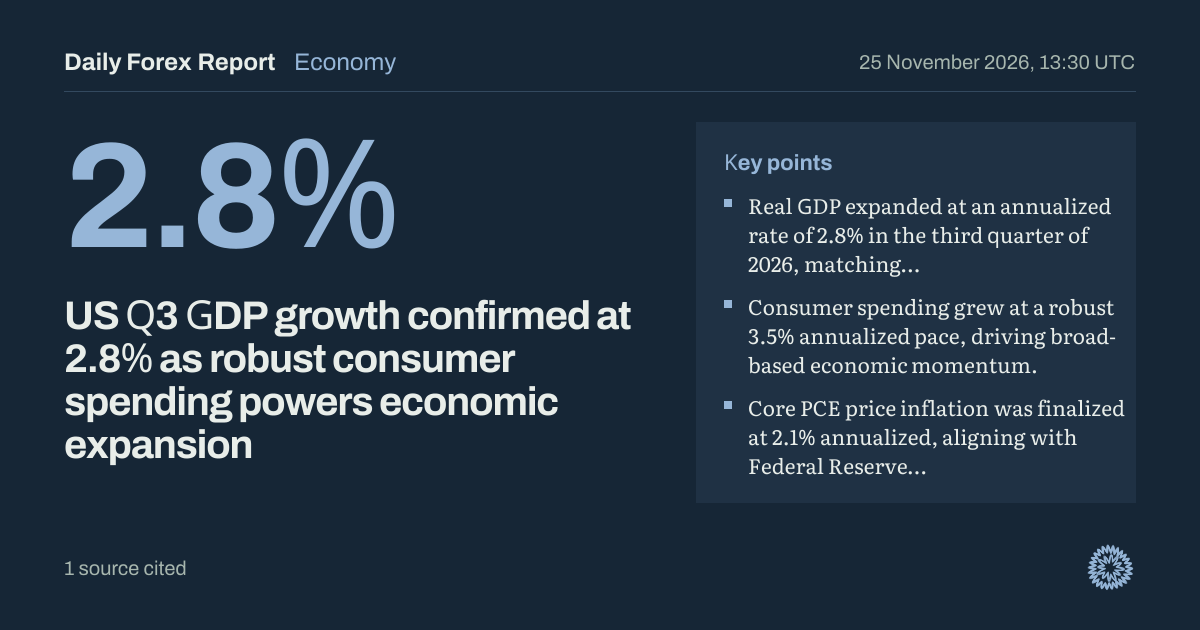
US Q3 GDP growth confirmed at 2.8% as robust consumer spending powers economic expansion
Second estimate of US third-quarter GDP held firm at an annualized rate of 2.8%, led by resilient consumer spending expanding at 3.5%.
Key points
- Real GDP expanded at an annualized rate of 2.8% in the third quarter of 2026, matching preliminary estimates.
- Consumer spending grew at a robust 3.5% annualized pace, driving broad-based economic momentum.
- Core PCE price inflation was finalized at 2.1% annualized, aligning with Federal Reserve baseline projections.
Economic expansion across the United States maintained vigorous momentum throughout the third quarter of 2026, according to the second estimate released by the Bureau of Economic Analysis on Wednesday, November 25. Real gross domestic product increased at an annualized rate of 2.8 percent, matching preliminary calculations and confirming that the world's largest economy continues to expand well above its long-term potential growth trend.
The primary engine of expansion remained household consumption, which accounts for roughly seventy percent of total domestic output. Personal consumption expenditures increased at a revised 3.5 percent annualized rate, reflecting enduring demand for healthcare, financial services, recreational goods, and motor vehicles. Simultaneously, corporate capital expenditure demonstrated underlying strength, with nonresidential fixed investment in equipment surging by 10.8 percent annualized.
Price measures embedded within the national accounts provided reassurance regarding disinflation progress. The core personal consumption expenditures price index, which strips out volatile food and energy costs, increased at an annualized rate of 2.1 percent during the quarter, landing near the central bank's two percent target. The combination of resilient domestic activity and controlled inflation reinforced expectations that the Federal Reserve will adopt a gradual, data-dependent approach to future rate reductions.
Financial markets exhibited steady pre-holiday trading following the report, with the US Dollar Index (DXY) consolidating near 107.00. Sovereign bond yields held firm, with benchmark two-year Treasury yields trading around 4.34 percent, as institutional investors evaluated the persistent growth divergence between the United States and sluggish European economies.